Baw Baw Shire · West Gippsland
Concreter Bunyip
Local concreting specialists serving Bunyip and the surrounding Baw Baw Shire. Residential and rural jobs, free on-site quotes.
Bunyip is a small town east of Warragul along the Princes Highway, roughly half an hour's drive from our base. The town and its surrounding area, including Bunyip North, mix residential streets with rural acreage and farming country, which means the concrete jobs here range from suburban driveways and paths to rural shed slabs and farm infrastructure. Warragul Concreting works across the Bunyip area for both residential and rural jobs.
Being on the highway, Bunyip is one of the more accessible towns east of Warragul, but the properties around Bunyip North extend into rural country where access and ground conditions become more challenging. We plan every Bunyip job around the specific site, whether it is a driveway in a residential street or a shed slab on a rural block, and we bring the right approach to each one.
Every Bunyip concreting project starts with a free on-site quote. We come to your property, assess the ground, the access and the levels, and give you honest advice about what is involved. No obligation, just clear information from a local team that works across Baw Baw Shire every week.
Residential Concreting in Bunyip
Bunyip's residential streets have a mix of established homes and newer builds, and the concrete needs here are similar to those in any growing West Gippsland town. We pour driveways, paths, patios and slabs for Bunyip homes, with the same attention to preparation and finish that we bring to every job. The local clay soils mean proper sub-base compaction and reinforcement are essential to prevent cracking.
A new or replacement driveway is one of the most common residential requests in Bunyip. We build driveways with the right thickness, reinforcement and drainage so they handle daily vehicle traffic and the local ground conditions. For homes with older, cracked driveways, we can assess whether a repair will do the job or a full replacement is the better long-term answer.
Rural Concrete Work Around Bunyip
Beyond the town itself, the Bunyip area extends into rural country, including Bunyip North, where the properties are larger and the concrete work is built for heavier use. Shed slabs are a frequent request, whether for a machinery shed, a workshop or a garden shed. We pour these with thickened edge beams and reinforcement matched to the intended load.
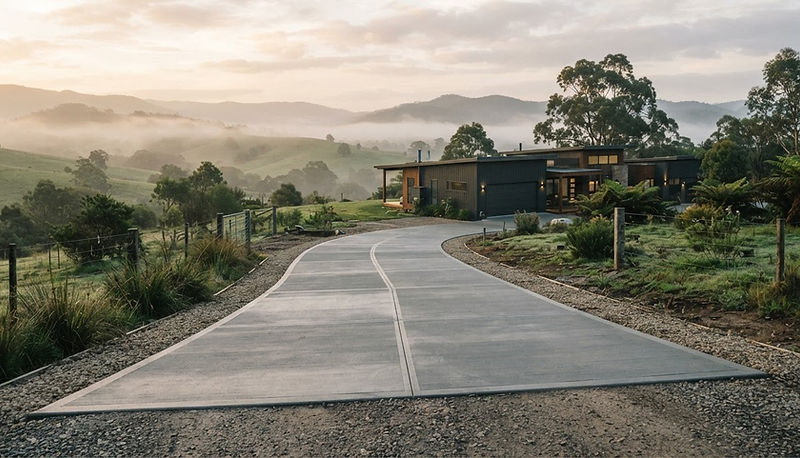
Rural driveways around Bunyip often run longer than suburban ones and may need to handle trucks and tractors as well as the family car. We prepare the sub-base along the full length, manage the fall for drainage, and pour a slab that handles the traffic without the maintenance headaches of gravel. We also pour water tank pads, hardstands and farm infrastructure for Bunyip rural properties.
Ground and Access in the Bunyip Area
The ground around Bunyip is typical of the West Gippsland plain, with reactive clay soils that move with the seasons. In the residential areas, the clay is fairly consistent, while the rural blocks toward Bunyip North can have more variation. We assess the soil on every site and adjust the sub-base, reinforcement and drainage to suit.
Access in Bunyip town is generally straightforward, but the rural blocks can have longer driveways or paddock conditions that require a concrete pump. We assess the access during the free site visit and arrange a pump if needed, so your Bunyip project gets done properly regardless of the terrain.
Soil and Site Preparation in Bunyip
The ground in and around Bunyip is shaped by the same reactive Gippsland clays that run right across Baw Baw Shire, and the residential areas share the same reactive clay as the rest of the West Gippsland plain. These clays swell when they take on moisture through the wet winters and shrink as they dry over summer, and that movement is the biggest threat to any concrete slab or surface in the area. We never pour on unprepared ground, every Bunyip job starts with excavation to a consistent depth and a compacted granular sub-base that drains freely and gives the concrete a stable platform.
Base compaction is the step that decides whether a slab lasts two decades or two years. We compact the sub-base in layers, confirm it is firm and even, and lay steel reinforcement so the concrete can span minor ground movement without cracking. Control joints are placed at calculated spacing so that when the clay does move, the slab flexes at the joint rather than splitting across the surface. On the most reactive Bunyip sites, we may deepen the edge beams or add a vapour barrier to break the capillary pull of moisture from the clay.
Because we work in Bunyip regularly, we know which pockets have the deepest clay and which areas are rockier or better drained. That local knowledge means we prepare every Bunyip slab, driveway or shed floor for the specific ground it sits on, not a generic guess. It is the part of the job you cannot see once the concrete is finished, but it is what keeps your Bunyip concreting project flat, level and crack-free for the long term.
Drainage and Gippsland Rainfall in Bunyip
Bunyip sits in West Gippsland, where close to 900 millimetres of rain falls in a typical year, much of it in heavy winter falls. Water is the quiet enemy of concrete, not because it harms the surface but because it erodes the ground beneath and around it. Every concrete job we pour in Bunyip is graded with a deliberate fall so that water runs off the surface and away from the building rather than pooling, ponding or tracking back toward footings.
Where a driveway, path or patio meets a lawn or paddock edge in Bunyip, we cut spoon drains or shallow surface channels to carry runoff away so it does not undermine the slab edge. On Bunyip sites with heavier groundwater or clay that holds moisture, and the flatter blocks can hold water through the wet months, we install agricultural, or ag, drains, a slotted pipe wrapped in aggregate and filter cloth that collects subsurface water and directs it to a legal discharge point. This keeps the ground under the slab dry and stable through the wettest months.
Good drainage design is invisible once the job is done, but it is the difference between a Bunyip concrete surface that ages gracefully and one that starts to dip, crack and spall after a few wet seasons. We assess the fall, the runoff paths and the soil on every Bunyip site during your free quote and build the right drainage into the job from the start.
Baw Baw Shire Permits and Crossings in Bunyip
Most concrete work on private land in Bunyip does not need a council permit in its own right, but there are important exceptions. A new driveway crossover, the section that crosses the nature strip from the road edge to your property boundary, almost always requires a vehicle crossing permit or consent from Baw Baw Shire Council. The council sets standards for crossover width, location, set-backs from intersections and sight lines, and the work must match their specification before they will sign it off.
For concrete work that is part of a building project in Bunyip, such as a house slab or an extension, the concrete is covered under the building permit and the engineer's design. For standalone work on private property, like a patio, path or shed slab, a separate council permit is generally not required, but we always recommend checking with Baw Baw Shire if you are unsure. We can advise on what is likely to apply during the site visit.
We are familiar with Baw Baw Shire's crossover standards and can pour the crossing to match the council specification, including the transition from the road edge, the fall back toward the property, and any required drainage. If your Bunyip project needs a vehicle crossing permit, we recommend applying before work begins so the pour is not held up, and we can talk you through the process during your free quote.
Our Concreting Process for Bunyip Properties
Every Bunyip concreting job follows the same proven sequence, and it starts with a free on-site quote. We come to your Bunyip property, look at the ground, the access, the levels and any existing structures, and talk through what you want to achieve. We assess the soil, measure the area, note any fall or drainage issues, and discuss finish options. You get honest advice and a clear quote that reflects your actual site, not a generic estimate.
Once you proceed, we schedule the work and begin site preparation. We excavate to the required depth, compact the sub-base in layers, set out the formwork to the correct levels and shape, place any vapour barriers, and lay the steel reinforcement to the design. On pour day we arrange the concrete delivery, place and compact the concrete, screed it to level, and finish the surface to your chosen standard.
After the pour, we place control joints at the right spacing, apply curing measures so the concrete gains strength without drying too fast, and seal decorative finishes where required. We advise on how long to wait before using the surface and on the ongoing maintenance that will keep your Bunyip concrete looking good and performing well for years. Because we are local, we are close by if you have any questions after the job is done.
Maintaining Concrete on Your Bunyip Property
A well-poured concrete surface on your Bunyip property needs very little maintenance, but a small amount of care goes a long way. Keep the surface clean with a regular sweep and an occasional wash, and keep drains and spoon drains clear of leaves and silt so water does not back up against the slab edge. This is especially important on Bunyip's clay country, where water held against a slab edge is a common cause of premature cracking and subsidence.
For decorative finishes like exposed aggregate and stamped concrete, reseal the surface every two to four years depending on exposure and traffic. The sealer protects the colour from UV fading, stops oil and organic stains from soaking in, and makes cleaning easier. For plain or brushed finishes, a simple sweep and occasional wash is all that is needed to keep the surface looking sharp.
Avoid harsh de-icing salts or strong chemical cleaners on any concrete surface, as they can attack the paste and the sealer over time. If you notice a crack developing on your Bunyip property, it is best to have it assessed early, a routed and sealed crack is a simple repair that stops water entry and prevents the crack from spreading. We are happy to take a look at any concrete we have poured in Bunyip and advise on maintenance at any stage.