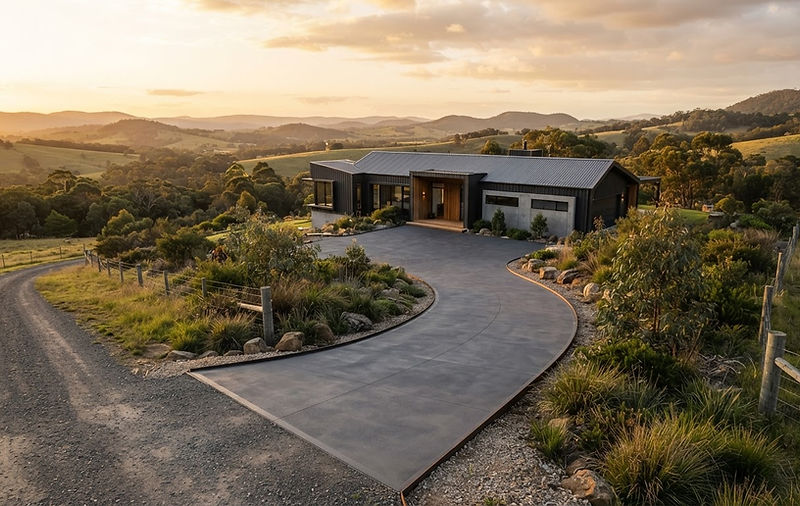
Concrete Driveways Warragul
Concrete Driveways Warragul
Local West Gippsland concreting specialists. Residential and rural jobs, free on-site quotes, quality finishes built to last.
A concrete driveway is one of the best investments you can make on a Warragul property. It takes you from the road to your front door every day, handles the weight of your vehicles, and has to survive the reactive clay soils and wet winters that run right across Baw Baw Shire. We build driveways that do all of that and still look sharp years after the pour.
As your local concreter, we pour driveways for homes and acreage throughout West Gippsland. From a straight residential run in a Warragul South estate to a long rural driveway approaching a Drouin farm, we prepare the ground properly, lay the right reinforcement, and finish the surface to suit your property and budget. Every driveway is graded so water runs off, not under, the slab.
New concrete driveways in Warragul
A new concrete driveway starts with the ground beneath it. Across Warragul and Baw Baw Shire, the reactive clay soils swell with winter moisture and shrink as they dry over summer, and that seasonal movement will crack a driveway poured on unprepared ground within a few years. We excavate to a consistent depth, compact a granular sub-base in layers, and lay steel reinforcement so the slab spans any minor ground movement without splitting.
Once the base is right, we set the formwork to the correct levels and falls, arrange the concrete delivery, and pour, screed and finish the surface in one continuous operation. A new driveway is walkable within a day and drivable within a week, and with the right preparation and finish it will serve a Warragul home for decades. We handle everything from the site visit to the final cure, so you deal with one crew from start to finish.
Plain vs coloured vs exposed vs stamped
The finish you choose changes both the look and the performance of your driveway. A plain grey trowelled finish is clean, practical and the most cost-effective option, suited to homes where a functional surface is all that is needed. A coloured concrete driveway uses oxide mixed through the concrete to give a uniform tone that complements your home, from warm earth tones to charcoal and slate grey. A brushed or broomed finish adds a fine texture for grip on sloped West Gippsland blocks.
For a premium look, exposed aggregate reveals the stones in the mix for a textured, decorative surface with excellent slip resistance, while stamped concrete presses a pattern into the surface to mimic stone, slate or brick. Both are sealed after curing to bring out the colour and protect against staining. We can show you samples and help you choose the finish that suits your home, your budget and the way you use the surface.
Long rural and acreage driveways
A driveway on a rural block or acreage is a different job from a residential run. Rural driveways are longer, often cross paddocks, and have to handle trucks, tractors and livestock as well as the family car. We prepare the sub-base along the full length, manage the fall so water does not run along or under the slab, and use a thicker, more heavily reinforced section where heavy vehicles will travel or turn.
Access is often the challenge on rural blocks, with long driveways, paddock conditions or sloped sites that a concrete truck cannot easily reach. We plan the pour around the available access, including using a concrete pump where needed, so your rural driveway gets done properly regardless of the terrain. We also handle the transition from the road crossover to your property boundary, including any drainage culverts or spoon drains needed to carry water under or around the driveway.
On the longest rural driveways, we may pour in sections to keep the job manageable and to work around the weather. Each section is prepared and poured to the same standard, with control joints at the right spacing and a continuous fall for drainage. The result is a single, continuous driveway that handles the weight of farm traffic and the wet West Gippsland weather, from the road to the front door of the property.
Base, thickness and reinforcement for cars, utes and trucks
The thickness and reinforcement of your driveway should match what it will carry. A standard residential driveway for cars and utes is typically 100mm thick with steel mesh reinforcement, which is enough for normal household traffic. For heavier vehicles, such as delivery trucks, tractors or a tradesperson's van, we increase the thickness to 125mm or 150mm and upgrade the reinforcement so the slab does not crack under the extra load.
The sub-base is just as important as the slab itself. We compact a granular sub-base in layers to give the concrete a stable, non-reactive platform that drains freely and does not heave with the clay underneath. Without a properly compacted base, even a thick slab will settle and crack over time. We assess your soil, your vehicle load and the expected traffic during the free site visit and specify the right combination of base, thickness and reinforcement for your driveway.
Crossover and council requirements
The section of your driveway that crosses the nature strip from the road to your property boundary is called a vehicle crossover, and it is the part of the job that may involve council. We recommend checking current Baw Baw Shire requirements for crossover width, location and construction standards before work begins, as these can change and vary by road type. We can advise on what is likely to apply during your free site visit.
For a new crossover, the council may require a vehicle crossing permit or consent, and the work must match their specification for width, set-backs from intersections and sight lines. We are familiar with the general standards and can pour the crossing to match, including the transition from the road edge, the fall back toward the property and any required drainage. If your project needs a permit, we recommend applying before work begins so the pour is not held up.
Drainage and falls on wet ground
West Gippsland receives close to 900 millimetres of rain in a typical year, and a good share of that falls in heavy winter downpours. Water is the quiet enemy of a driveway, not because it harms the surface but because it erodes the ground beneath and around it. Every driveway we pour is graded with a deliberate fall, usually around one in fifty, so that water runs off the surface and away from the building rather than pooling or tracking back toward footings.
Where a driveway meets a lawn or paddock edge, we cut spoon drains or shallow surface channels to carry runoff away so it does not undermine the slab edge. On sites with heavier groundwater or clay that holds moisture, we install agricultural drains, a slotted pipe wrapped in aggregate and filter cloth that collects subsurface water and directs it to a legal discharge point. Good drainage design is invisible once the job is done, but it is the difference between a driveway that ages gracefully and one that starts to dip and crack after a few wet seasons.
Rip-out and replace
Many Warragul homes still have driveways that were poured decades ago, often too thin or without proper reinforcement. If your driveway is cracking, sinking at the edges, holding water or has large sections that have shifted, it may be time to replace it. We remove the old concrete, assess the sub-base underneath, and pour a new slab that is built to current standards with the right thickness, reinforcement and falls.
If your driveway only has isolated cracks or surface damage, a targeted repair may be all that is needed before committing to a full replacement. See our concrete repairs page for more on crack filling, patching and resurfacing. We will give you honest advice on whether a repair or a full replacement is the better option for your driveway during the free site visit.
Sealing and aftercare
Sealing your driveway protects the surface from oil and organic stains, makes cleaning easier and, for decorative finishes, brings out the colour. We seal every exposed aggregate and stamped concrete driveway we pour and recommend resealing every two to four years depending on exposure and traffic. See our concrete sealing page for more on sealer types and resealing schedules.
For plain and brushed finishes, a simple sweep and occasional wash with a hose or pressure cleaner, using a wide-angle nozzle, is all the maintenance needed. Keep drains and spoon drains clear of leaves and silt so water does not back up against the slab edge. If you notice a crack developing, it is best to have it assessed early, as a routed and sealed crack is a simple repair that stops water entry and prevents the crack from spreading.
Our process, from site visit to cure
Every driveway job starts with a free on-site quote. We come to your property, look at the ground, the access, the levels and any existing structures, and talk through what you want to achieve. We assess the soil, measure the area, note any fall or drainage issues, and discuss finish options. You get honest advice and a clear quote that reflects your actual site, not a generic estimate.
Once you proceed, we schedule the work and begin site preparation. We excavate to the required depth, compact the sub-base in layers, set out the formwork to the correct levels, and lay the steel reinforcement. On pour day we arrange the concrete delivery, place and compact the concrete, screed it to level, and finish the surface to your chosen standard. After the pour, we place control joints at the right spacing and apply curing measures so the concrete gains strength without drying too fast. We advise on how long to wait before walking and driving on the surface, typically around seven days for light vehicles.